
Andrew Chen spent years leading rider growth at Uber and now invests at Andreessen Horowitz. This book is his attempt to take the most overused phrase in Silicon Valley pitch decks, “network effects,” and turn it into something actually useful. He talked to over a hundred founders from companies like Tinder, Slack, Airbnb, Reddit, and PayPal, and what he came back with is a five-stage framework for how networked products are born, how they grow, and how they die.
What is a network effect?
A network effect is when a product becomes more valuable as more people use it. A phone is useless if nobody else has one. A marketplace with no sellers has nothing to buy. A social network with no friends is just an empty feed.
Every networked product has two components: the product (the software) and the network (the people). Uber’s product is the app. Its network is the riders and drivers active at any given moment. Airbnb doesn’t own rooms. YouTube doesn’t own videos. The value is in the connection, not the asset.
Network effects matter because they’re one of the few real defensive moats in tech. Software is cheap to build and easy to copy. When Instagram launched Stories, Snapchat couldn’t just copy Instagram’s network back. Features are replicable. Networks aren’t.
But here’s the thing nobody talks about: at the beginning, network effects work against you. No users means no value. No value means no reason to join. This is the Cold Start Problem, and it kills more startups than bad products or tough competition ever will.
The framework
Chen argues that network effects follow a predictable lifecycle with five stages:
- The Cold Start Problem — the network has no users and therefore no value
- The Tipping Point — growth becomes self-sustaining and repeatable
- Escape Velocity — three forces amplify the network’s growth
- The Ceiling — growth stalls from saturation, degradation, and revolt
- The Moat — the network becomes a competitive advantage (or doesn’t)
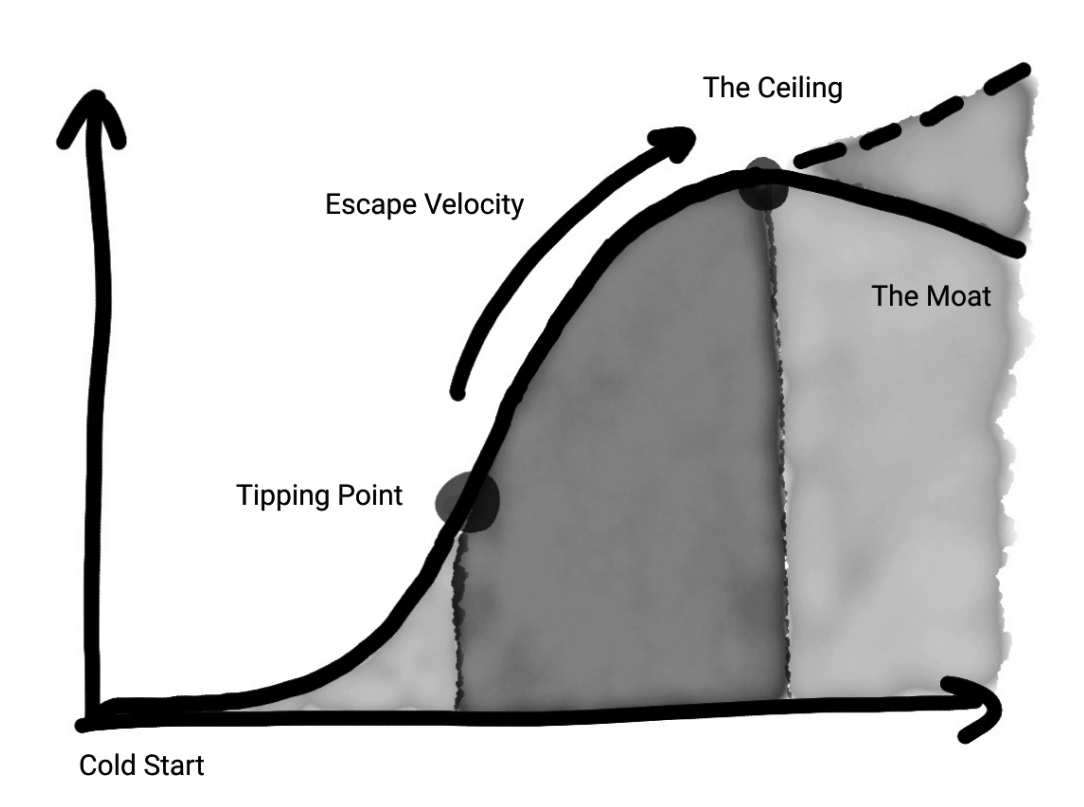
Each stage demands different strategies. What follows is what I took from each one.
Stage 1: The Cold Start Problem
The atomic network
The most counterintuitive idea in the book is the atomic network: the smallest possible group of users that can sustain itself and actually find the product valuable. Not a market segment. Not a demographic. Something embarrassingly specific.
Chen’s best example is the Fresno credit card drop. In 1958, Bank of America wanted to launch credit cards, but they faced the classic chicken-and-egg: no consumers would want a card if no merchants accepted it, and no merchants would accept it if no consumers had one. So they picked Fresno, California, a mid-sized city where 45% of families already banked with them. On a single day, they mailed 60,000 unsolicited cards to Fresno residents and signed up 300 local merchants. It was messy and risky, but it worked. Within 13 months they had 2 million cards and 20,000 merchants across California.
The lesson is: don’t try to win the whole market. Win one tiny, dense pocket first. Facebook started at Harvard, not “college students.” Uber started at one specific intersection in San Francisco during rush hour, not “cities.” For Slack, the atomic network was a single team of three people. For Zoom, it was literally two people wanting to have a conversation.
Every product has a critical density threshold, the number of users needed before the product experience becomes viable. Slack found that teams needed to exchange about 2,000 messages before the product really clicked, and after that 93% of customers retained. Airbnb needed about 300 listings with 100 reviewed in a single city. Uber needed 15 to 20 concurrent drivers with ETAs under 3 minutes. The higher the threshold, the harder the cold start, but also the more defensible the product becomes long-term.
The hard side
Every network has an easy side and a hard side. The hard side is the small group that does disproportionate work and creates disproportionate value. Wikipedia has 500 million monthly visitors, but its 4,000 most active editors, just 0.02% of its user base, wrote the whole thing. One guy, Steven Pruitt, a US Customs officer, has made nearly 3 million edits and written 35,000 articles. Unpaid.
On Uber, the hard side is drivers. On YouTube, it’s creators. On any marketplace, it’s usually sellers. If you get the hard side, the easy side follows. If you don’t, nothing else matters.
Understanding why the hard side participates is crucial. Content creators are driven by social feedback loops: publish, receive likes and comments, create more. Marketplace sellers want revenue. Wikipedia editors work for free, motivated by status within the community, expertise display, and a sense of purpose. You have to solve for their specific motivations, not just assume “build it and they will come.”
The killer product
Zoom didn’t win by being the most feature-rich video app. It won by being the simplest. It just worked. When you’re trying to solve the cold start, every barrier to joining and using the product is a potential death sentence.
Chen points out that the best networked products can be described in one sentence. This makes them easy to spread virally but also easy to dismiss as “features, not products.” That simplicity is precisely the point. The network is the defensibility, not patents or features.
Freemium pricing directly addresses the cold start: charging users adds friction to network building. Zoom’s founder Eric Yuan studied Dropbox’s free tier (free up to 2GB) and designed Zoom’s 40-minute meeting cap so users could experience the full product before paying. Zoom grew for four years without a marketing team.
Anti-network effects
Anti-network effects are the destructive force at a network’s beginning. Users arrive, find no one, and leave. This creates a vicious cycle that drives most new networks to zero. Chen emphasizes that the myth of instant hockey-stick growth is exactly that, a myth. The reality for most startups is an initial spike followed by decline as novelty fades and the network remains too sparse.
Chen borrows from ecology to explain this. Just as animal populations like meerkats and sardines have an Allee threshold below which the group spirals toward collapse, networks have a tipping point below which they self-destruct. Below critical mass, fewer users means less value means even fewer users. Above it, growth becomes self-sustaining. And just like ecosystems, networks have a carrying capacity where overcrowding creates diminishing returns. Metcalfe’s Law (“value grows as the square of nodes”) is dangerously incomplete because it ignores all of this.
Stage 2: The Tipping Point
Once you know how to build one atomic network, the game becomes making that process repeatable. Chen describes several strategies:
Invite-only
LinkedIn’s cofounder Reid Hoffman seeded the network with mid-tier successful professionals, not Bill Gates (who’d be overwhelmed), but ambitious people still building their careers. Within the first week, employees and investors invited their professional contacts, who invited theirs. The insight is that invite-only works not primarily because of hype, but because it’s a copy-and-paste mechanism: a curated initial network, given invites, will replicate itself with similar high-quality users. The most connected people get invited first and invite other highly connected people, creating a “dinner party of social butterflies.”
But the Gmail story is the one I keep thinking about. Gmail wasn’t intentionally invite-only as a growth hack. It launched on April Fool’s Day 2004 running on 300 old Pentium III computers. The servers simply couldn’t handle open signups. But the scarcity accidentally created enormous demand. Invites were selling on eBay for $150. Entire websites like Gmail Swap popped up where people traded invites.
Part of the frenzy was about the product itself, but part of it was about usernames. Everyone understood intuitively that tom@gmail.com would exist exactly once, and that the longer you waited, the worse your options got. Early adoption had a permanent, visible reward.
This reminded me of ai.com. They launched with a username claim page where you could grab ai.com/@yourname before someone else does. The psychology is the same: everyone knows that short, clean usernames like ai.com/@tom won’t last forever, and nobody wants to end up with something like zigao.wang24cats when they could have just @ZigaoWang. So people rush to sign up. But unlike Gmail, which had a genuinely great product waiting when you got your invite, ai.com’s product isn’t actually ready yet. They created the urgency, but there’s nothing behind it.
Come for the tool, stay for the network
Before Instagram, there was Hipstamatic, a paid app with vintage photo filters that Apple named App of the Year. Millions of people downloaded it. But Hipstamatic was just a tool. You took a photo, applied a filter, and it saved to your camera roll. If you wanted to share it, you had to go somewhere else.
Instagram started life as a completely different app called Burbn, a cluttered location-sharing app. Kevin Systrom and Mike Krieger stripped it down to just photos, comments, and likes, and renamed it Instagram. It offered similar filters to Hipstamatic but free, better designed, and built with network features from day one: profiles, feeds, and sharing links that drove viral growth back to the app. People shared their filtered photos to Facebook, which pulled their friends into Instagram. The tool got people in the door. The network made them stay. Today, 82% of Instagram photos use no filter at all. The thing that originally attracted people became almost irrelevant.
The framework: if your product is useful to one person alone, people will show up even when there’s no network. Then you layer the network on top. This works for a whole category of products: YouTube (create and share), GitHub (code alone, collaborate with others), Dropbox (sync your own files, share folders), Pinterest (organize for yourself, share boards). But the pivot from tool to network is fragile. Thousands of photo apps tried to copy Instagram’s formula and failed. The coupling between the tool and the network has to feel natural, not bolted on.
This one sticks with me because it maps directly onto what I’m trying to build with AvoidXray, a film photography community. Right now people can come to showcase their film photos, and that’s the tool. The question is whether the community layer can grow strong enough that people stay for each other, not just for a place to upload. Instagram proved it’s possible. Hipstamatic proved it’s not guaranteed.
Paying up for launch
Sometimes you just pay to get the network started. Uber launched new cities with $30/hour driver guarantees via Craigslist job ads, then executed a “commission switch” to sustainable economics once critical mass was reached. Coca-Cola literally invented the coupon in 1888, giving away 8.5 million free drinks to build nationwide brand presence. Bitcoin’s protocol rewards early miners with disproportionate cryptocurrency, aligning incentives without requiring a central company to burn cash.
The key insight is that subsidies should come after you’ve validated the product and atomic network concept. Money accelerates a proven playbook. It doesn’t replace one. And you need an exit plan, because the goal is always to transition from subsidized to self-sustaining economics. This requires capital, obviously, which means it’s not available to everyone. I haven’t been able to apply this one.
Flintstoning
Reddit’s cofounders, Steve Huffman and Alexis Ohanian, had a problem: who wants to browse a link-sharing site with no links? So they posted everything themselves, under dozens of fake accounts, for months. They made the site look alive until real users showed up. Later they built scrapers and bots to automate it, and eventually organic submissions took over. They found that individual subreddits needed about 1,000 subscribers each to become self-sustaining.
This is called Flintstoning, named after the Flintstones’ car that looks like it runs on its own but is actually powered by Fred’s feet underneath. You manually fill in the hard side of the network until the real thing takes over. YouTube’s founders uploaded the first videos. DoorDash listed restaurants that hadn’t even signed up, then sent couriers to order food as regular customers. PayPal built bots that bought and sold items on eBay but insisted on PayPal-only transactions, forcing sellers to adopt the service.
At the extreme end, this scales into entire organizations. Nintendo builds internal game studios employing hundreds of people to create first-party titles like Mario and Zelda for new console launches. Microsoft acquired nearly a dozen game studios, including Mojang (Minecraft) for $2.5 billion. Sometimes you simply have to build the hard side yourself.
I’ve lived this one. With AvoidXray, I uploaded a lot of my own film photos to seed the platform. It works. The site looks active, there’s content to browse. But the moment I stop posting, the stream dries up. That’s the fundamental limitation of Flintstoning: it gets you started, but it can’t carry you. And if you keep doing it too long, you actually crowd out the real contributors, because you’re absorbing the engagement (likes, comments, attention) that should be incentivizing genuine users to participate.
Always be hustlin’
Uber’s tipping point strategy was fundamentally about decentralized, creative hustle. Each new city was its own cold start problem, and autonomous local teams used whatever worked: street teams, Uber Puppies, Uber Ice Cream, Uber Mariachi Band, Uber Helicopter, celebrity first riders, and holiday campaigns tied to July 4th and Pride Parade. What matters isn’t any single tactic. It’s building an organizational structure that can generate endless creative variations and iterate rapidly.
The Tinder launch belongs here too. The founding team threw a birthday party for a popular, hyperconnected student at USC. They bused people to a luxury house in LA with a bouncer at the door. The catch: you had to show Tinder downloaded on your phone to get in. A few hundred of the most socially active students walked into a party with the app on their phones. The next morning, they opened it and found the attractive, interesting people from last night that they didn’t get a chance to talk to. Within months, the team was repeating this at campus after campus. In India, they swapped college campuses for call centers, dense communities of young people who already knew each other. They found that around 20,000 users in a single market was enough for organic growth to take over. No grand launch. No press blitz. Just parties.
Chen also confronts the uncomfortable reality that hustle sometimes pulls companies into gray areas. YouTube grew partly on pirated content. PayPal had to build fraud detection systems on the fly. Uber pivoted from licensed black cars to peer-to-peer ridesharing, inviting regulatory controversy. The pattern: embrace the momentum, then build controls over time.
Stage 3: Escape Velocity
Once you’ve solved the cold start and hit a tipping point, the next challenge is scaling. Chen breaks “network effects” into three distinct forces, which he calls the trio of forces:
The Engagement Effect
As the network grows, existing users become more engaged. More content to see, more people to interact with, more use cases that emerge. When Slack first launches in a company, it’s a messaging tool. As more teams join, specialized channels appear. Uber had a “Pool Party” channel, Andreessen Horowitz had channels for books, movies, and futurism. The product becomes stickier not because of new features, but because the network itself generates new reasons to stay.
The practical framework: segment users by engagement level and find different levers for each. LinkedIn’s growth team discovered that what helps an infrequent user (suggesting colleagues to connect with) is completely different from what helps a power user (advanced search, content publishing). One-size-fits-all doesn’t work.
Networked products also have a unique superpower for reactivation. Up to 75% of registered users may be inactive, but a network-driven notification (“your boss shared a folder with you,” “a friend just joined”) is far more compelling than a marketing email. These can flip “dark nodes” back to active in ways non-networked products simply can’t.
The Acquisition Effect
The network itself becomes the main channel for acquiring new users through viral growth. PayPal is the central story here. It started as a PDA-based payment tool, pivoted to internet payments, and discovered that eBay sellers were already creating “We accept PayPal” badges on their listings without being asked. PayPal supercharged this with $10 sign-up bonuses for both inviters and invitees, growing from under 10,000 to 5 million users in about a year.
The master metric is the viral factor, the ratio of new users each cohort generates. At 0.5, you double your users. At 0.95, you get 20x amplification. Small optimizations (5-10% per step) compound across dozens of A/B tests, and the math becomes powerful as the factor approaches 1.0.
But Chen warns that acquisition without engagement is hollow. He uses the 1930s “Prosperity Club” chain letter as an example, a network with strong virality but no retention. It spread to hundreds of thousands of people via mail, promising money from dime exchanges. It overwhelmed Denver’s post offices and was eventually made illegal. Strong acquisition, zero stickiness, inevitable collapse.
The Economic Effect
The network’s economics improve as it scales. Better monetization, lower costs per user, stronger pricing power. Uber’s per-trip subsidy costs dropped dramatically as driver density increased. The same $30/hour guarantee cost $15 per trip early on but dropped to $2.50 as trip frequency doubled. Slack’s premium features like voice calling and searchable history become more compelling as more of a company adopts the product, driving organic free-to-paid conversion.
Features can be copied. Networks can’t. Products with strong network effects face less price competition because switching costs are embedded in the network itself. When all your coworkers are on Dropbox, the cost of switching isn’t learning new software. It’s losing all your shared folders.
These three forces are mutually reinforcing. Higher engagement creates more sharing opportunities, boosting acquisition. More new users keep the existing community engaged. Stronger monetization incentivizes more participation on the hard side. Amplifying one lifts the others.
Stage 4: The Ceiling
Growth doesn’t last forever. Every network eventually hits a ceiling, and often multiple ceilings in sequence.
Saturation
At some point, you’ve reached most of the people who would use your product. eBay hit this around 2000 when month-over-month growth flatlined for the first time. The response was layering new products on top of the existing network: “Buy It Now” fixed pricing (now 62% of eBay’s $40B+ GMV), seller stores, improved checkout, and PayPal integration. What looks like exponential growth from the outside is usually many S-curves stacked on top of each other, each requiring its own cold start solution.
There’s also network saturation, which is subtler. Each new connection yields diminishing returns. Snapchat’s internal data shows a user’s top friend drives 25% of send volume while the 18th friend contributes less than 1%. Facebook’s “7 friends in 10 days” metric captured this too: 7 connections is powerful, 14 is better but not 2x better, and 10,000 friends might actually decrease engagement through noise.
Instagram fought saturation using the Adjacent User framework. At 400 million users, growth had gone linear. The growth team identified about eight distinct types of potential users who were aware of the product but couldn’t fully engage, from US women aged 35-45 to women in Jakarta on older 3G Android phones. They solved for each segment sequentially and reignited growth past a billion users.
The Law of Shitty Clickthroughs
Every marketing channel degrades over time. The first banner ads on Hotwired in 1994 had a 78% clickthrough rate. Today they get 0.3-1%. Email marketing dropped from 30% to 13%. This applies to viral channels too: a 50% decline in invite conversion causes roughly an 80% decline in total viral growth because of compounding across invitation generations.
The defensive response is constantly layering new acquisition channels rather than over-investing in any single one. The offensive response is leaning into network effects themselves as the primary growth engine. Buying billions of installs at $10+ each is simply not viable.
When the network revolts
The hard side’s importance grows as the network matures, and so does their leverage. Uber drivers protested outside headquarters demanding higher pay. Vine’s top 18 creators organized a collective ultimatum demanding $1.2 million each and feature changes. Vine refused. The platform eventually shut down.
The concentration is extreme. Uber’s top 15% of drivers handled 40% of trips. Slack’s top 1% of customers generated 40% of revenue. Zoom’s top 344 accounts, under 1%, generated 30% of revenue. The same feedback loops that make the hard side productive also give them the organizational power to revolt.
As platforms mature, the hard side naturally professionalizes. Part-time eBay sellers become full-time businesses. Casual YouTube creators build production teams. This is necessary because as markets saturate, acquiring new hard-side members gets prohibitively expensive. But professionalization concentrates power among fewer players, creating a structural tension that never fully resolves.
Uber’s XChange Leasing program is a cautionary tale: the company lost $525 million trying to professionalize drivers by financing vehicles, attracting the wrong incentive profiles and enabling fraud. Some of those cars ended up as far away as Iraq and Afghanistan.
Eternal September
In 1993, AOL mailed millions of internet access CDs across America, flooding Usenet, the internet’s first global discussion system, with new users who overwhelmed its decade-old culture of “netiquette.” The core community fragmented and migrated elsewhere. By 2010, major institutions had shut down their Usenet servers. Dave Fischer famously observed: “September 1993 will go down in net history as the September that never ended.”
The broader concept is context collapse: when a network grows so large that distinct social contexts (close friends, colleagues, bosses, parents) merge into one undifferentiated audience. Creators self-censor or leave, which causes consumers to leave too, triggering a vicious cycle. The defense is building networks within networks: messaging threads, Slack channels, Facebook Groups, Instagram “finstas,” Snap Stories. These let users maintain distinct contexts even as the overall network scales to millions.
Usenet’s decentralized, open-source nature, once a virtue, became fatal because no entity had the resources, authority, or speed to adapt when millions of new users arrived simultaneously. Centralized companies, for all their downsides, can iterate fast enough to fight context collapse.
Overcrowding
Too much content, too many participants, too many signals make it increasingly hard for anyone to find what they want or stand out. YouTube started as a dating site with zero videos and evolved through chronological lists, to hand-curated homepage picks, to popularity rankings, to algorithmic recommendations. Every networked product follows this same discovery evolution as it scales.
Overcrowding affects both sides differently. Consumers struggle to find relevant content. Creators struggle to stand out. The preferential attachment problem means early, established users accumulate disproportionate advantages in followers, ratings, and visibility, potentially driving new creators to competing platforms with more level playing fields. Eugene Wei calls this “Old Money”: early users on social networks accumulate outsized social capital, creating status inequality.
Algorithms help but create their own problems. Optimizing for pure engagement can reward controversial clickbait. Optimizing for revenue can surface high-priced, low-relevance items. The fight against overcrowding never truly ends.
Stage 5: The Moat
Network effects create defensibility because competitors must solve their own cold start problem against an incumbent with existing density. But simply having network effects isn’t a magic shield. Every player in a networked category has them. The real question is who leverages them best.
Cherry-picking
Large networks are networks of networks, and not every sub-network is well-served. Startups can strategically pick off the most valuable, underserved segments. Andrew Parker’s famous 2010 observation mapped this out: Indeed took jobs from Craigslist, StubHub took tickets, Etsy took crafts, Airbnb took rooms, Tinder took dating, Zillow took real estate.
Airbnb literally reverse-engineered Craigslist’s posting system to automatically cross-post listings with links driving users back to Airbnb. Facebook and LinkedIn grew by importing contacts from Hotmail and Yahoo Mail. Snapchat carved out photo messaging, one high-frequency use case, from broader social networks, generating 10-20 messages per active user per day.
The risk is platform dependence. If you remain just a feature of the incumbent’s ecosystem, you’re vulnerable to being copied or cut off.
Big Bang Failures
The “Big Bang Launch,” launching to a massive, broad audience simultaneously, is structurally wrong for networked products. Google+ is the definitive example. It signed up 90 million users by leveraging Google’s homepage and product ecosystem. Users averaged 3 minutes per month versus 6-7 hours on Facebook. The problem: broad distribution creates many weak, disconnected networks rather than dense, engaged ones. The aggregate numbers looked impressive. The underlying networks were hollow.
The paradox of small markets: the first atomic network almost always looks like a trivially small, unattractive market. eBay started in stamps and coins. Airbnb started with air mattresses on living room floors. TikTok started with lip-syncing videos. Fred Wilson at Union Square Ventures passed on Airbnb. Bessemer Ventures called eBay a “no-brainer pass.” These are among the most successful networked products ever built. You can’t skip the atomic network phase by throwing distribution at the problem.
Competing over the hard side
When two networks of similar size compete, the battle comes down to who captures the hard side. Uber built elaborate systems to identify “dual-apping” drivers using machine learning, behavioral signals like pausing and unpausing sessions, and even Android APIs detecting competing apps. They deployed targeted financial incentives, including tiered bonuses, guaranteed surge multipliers, and personalized weekly offers, spending over $50 million per week in a single region at peak. This successfully eliminated smaller competitors like Sidecar (which described markets “going to zero” within 6 weeks of stopping bonuses), but stalled against Lyft in markets where the split was roughly 50/50.
DoorDash offers a counter-lesson: rather than competing head-on with Uber Eats in cities, they started in underserved suburbs and college towns, built strong economics there, then expanded into urban markets. A flanking maneuver rather than a direct assault.
Bundling
Bundling, using an existing large network to distribute a new product, sounds like an unfair advantage. But Chen’s point is that it almost never works the way people expect.
Internet Explorer shipped with every copy of Windows. It still only captured 3-4% of the browser market at first, because the product was terrible. It took Microsoft years of genuine product investment to actually compete with Netscape. Bing has been bundled across Windows, Edge, and every Microsoft product for years. Nobody uses it. Google+ leveraged Google’s homepage, YouTube, Gmail, and Photos. It signed up 90 million users, and they averaged 3 minutes per month.
When bundling does work, it requires two things: a genuinely excellent product and the ability to leverage the parent network not just for user acquisition but for engagement and retention. Instagram used Facebook’s social graph to recommend real-life friends, which dramatically boosted long-term retention. That’s genuine network integration, not just a download prompt. Microsoft Office succeeded because Word and Excel were rewritten to be genuinely superior during the DOS-to-GUI transition, and then combined with Windows distribution.
Distribution gets people to the door. It doesn’t make them stay. This applies at every scale. It’s tempting to think that if you could just get your product in front of enough people, growth would follow. But the Wimdu story, the Google+ story, and the Bing story all say the same thing: if the product or the network quality isn’t there, more eyeballs just means more people bouncing off.
All supply is not created equal
The Airbnb vs. Wimdu story is the clearest example in the book of why the moat is about network quality, not just network size. Wimdu was a Berlin-based clone launched in 2011 by the Samwer brothers, who had previously cloned eBay and Groupon in Europe and sold both back to their American originals. Wimdu came out swinging: $90 million in funding, 400 employees, 50,000 listings in the first year. They scraped Airbnb’s listings, posed as guests to recruit hosts, and copied the design down to the taglines.
But Wimdu’s top 10% of inventory was equivalent to Airbnb’s bottom 10%. They had recruited property managers running low-end hostels, not the unique, authentic hosts that made Airbnb special. Guests showed up expecting something personal and got something forgettable. No word of mouth. No magic. No reason to come back. Wimdu went to zero within a few years.
Brian Chesky’s key insight was that the Samwers wanted a quick flip, not an 18-year commitment. By refusing to acquire Wimdu and forcing them to compete long-term, Airbnb exploited its competitor’s fundamental misalignment of incentives. Airbnb’s organic, years-old European supply, though smaller, had already formed authentic atomic networks with high guest satisfaction and genuine word of mouth.
My take
The book follows five stages and the framework is solid. But the front half hit much harder than the back half for me. The concepts around atomic networks, Flintstoning, solving for the hard side, come for the tool: these are my actual problems right now. I’m building AvoidXray, a film photography community. I’m seeding it with my own content. I’m thinking about how to turn a tool into a community. The early chapters gave me a vocabulary for things I was already experiencing but couldn’t name.
The later sections on hitting ceilings and building moats are interesting, but they’re about problems I haven’t had yet. When you’re still at stage one, reading about how Uber managed driver revolts or how YouTube evolved its recommendation algorithm feels abstract. There are plenty of stories but fewer clear “here’s what you should do” moments. I think this is partly a “where you are” problem. If I were already scaling, the back half would probably resonate more.
That said, some ideas from the later sections are useful even at stage one. The bundling lesson, that distribution without product quality is worthless, applies whether you have a million users or a hundred. The Wimdu lesson, that quantity of supply means nothing if the quality is hollow, matters from day one. And the Law of Shitty Clickthroughs is a reminder not to over-invest in any single growth channel, no matter how well it’s working right now.
The book is also repetitious in places. It keeps reminding you it’s called The Cold Start Problem, but the cold start section isn’t even the longest part. The five-stage framework covers the entire lifecycle of a networked product, and the later stages matter just as much for building a real business. The title undersells the scope.
But the stories are genuinely good. The Fresno credit card drop, Tinder’s campus parties, Reddit’s fake accounts, Wimdu’s hollow listings, Gmail’s accidental scarcity, Google+‘s 3 minutes per month. These aren’t abstract business concepts. They’re specific, memorable, and they change how you think about the thing you’re building.
Concepts I’ll carry forward
- Atomic network: start with the smallest viable community, not the whole market
- The hard side: figure out who creates the value and attract them first
- Come for the tool, stay for the network: give people a reason to show up before the network exists
- Flintstoning: manually seed activity, but know it doesn’t scale and have an exit plan
- Dense communities first: campuses, cities, niche groups. Saturate one before expanding
- Anti-network effects are the default: the vicious cycle of emptiness kills more than competition does
- The Law of Shitty Clickthroughs: every channel degrades, so layer them constantly
- All supply is not created equal: quality of the hard side matters more than quantity
- Distribution is not enough: bundling, big launches, and big numbers mean nothing without product quality and genuine network density
- The Cold Start Problem itself becomes the moat: once your network reaches critical mass, competitors have to solve the same bootstrapping challenge from a worse position