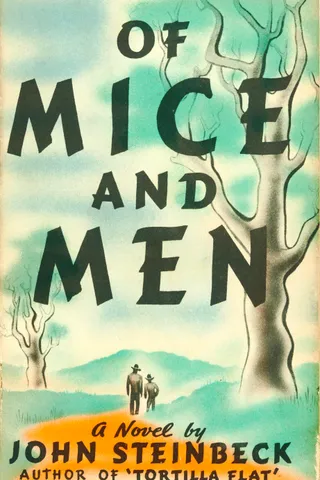
I don’t read fiction. The last two novels I finished were The Martian and Uglies, and I read those because I kind of had to. I never understood why anyone would sit down with a made-up story when they didn’t have to. You could just tell me the thing.
Then yesterday I opened Of Mice and Men and didn’t put it down. Finished it in a day. And then I just sat there for a while after the last page, kind of stuck. I want to write down what I thought while it’s still mine.
If you haven’t read it, go read it first. It’s short, it’s easy, you can do it in an afternoon, and the ending is worth going in blind for. That’s the whole spoiler-free pitch. Come back after.
The setup, quickly
For anyone who hasn’t read it, here’s the bare bones. It’s 1930s California, the Great Depression. George and Lennie are two migrant ranch workers who travel together looking for work. George is small and sharp. Lennie is huge, incredibly strong, and intellectually disabled, with the mind of a child. He loves soft things and keeps accidentally killing them because he doesn’t know his own strength. The two of them share a dream: save up, buy a little farm, and live off the land, with Lennie tending rabbits.
That’s the engine of the whole book. Two guys with nothing but each other and a dream that feels just barely possible.
It’s an easy read, and that mattered
The book is easy. No hard language, nothing you fight through. A lot of it is how the characters talk. They say stuff like “ain’t no good,” double negatives everywhere, and at first I thought, wait, don’t two negatives cancel? But not here. The second negative doesn’t cancel the first, it makes it stronger. “Ain’t no good” means really not good.
These are uneducated migrant workers and Steinbeck writes them exactly how they’d sound. It made the whole thing feel less like reading a book and more like listening in on real men talking.
Spoiler alert from here on. I’m going to talk about the ending.
The ending
Lennie accidentally kills Curley’s wife (Curley is the boss’s son, a mean little guy). He doesn’t mean to, he just panics and grabs too hard, same as he did with the mice and the puppy. Then he runs to a spot by the river that he and George had agreed on in advance, in case anything ever went wrong.
I thought this was the escape. I thought George would show up and the two of them would disappear and start over somewhere, the way they always talked about. Instead George finds him, has him look out at the water and describe the farm and the rabbits one more time, and while Lennie’s lost in the dream, George shoots him in the back of the head.
I said what the hell out loud.
My first read was that George was secretly mean. The whole book he’s irritated at Lennie, always going on about how easy his life would be without him. So when he pulled the trigger I thought, oh, that was the real George the whole time, and the nice guy was the mask.
But the longer I sat with it the more I flipped. The thing I’d missed is what was actually coming for Lennie. Curley had a mob together and he wanted Lennie to suffer. He literally tells the others to shoot him in the guts so he dies slow. The only other option was Lennie getting locked up in an institution, caged for the rest of his life. So George’s choice was never “kill Lennie or save him.” It was “do I do this myself, gently, or do I let Curley do it with a mob and a grudge.”
Looking it up after, that’s pretty much how everyone reads it. People call it a mercy killing, the same kind of thing as when a vet puts down an animal that’s suffering. And the part that gets me is that George does it himself. He could’ve stepped back and let Curley’s mob have him, or let Carlson, the guy who shot Candy’s dog, do the dirty work. He doesn’t. He takes the whole weight of it onto himself instead of handing it off. He does it fast, painless, while Lennie is at his happiest, hearing about the rabbits, so the last thing in his head is the dream and not fear. It’s about as gentle as a killing can be, and it costs George everything.
So which is it, mean or kind? I genuinely couldn’t land on one, and it turns out the book doesn’t want me to. George resents Lennie and loves him. Both are true. That’s why the ending hurts instead of just being sad.
Some things I noticed
A few things jumped out at me that I’m kind of proud I caught on my own.
Curley’s wife never gets a name. She’s the only main character without one, just “Curley’s wife,” defined by which man she belongs to. And right before she dies she talks about how she’d wanted to be in the movies, how she had dreams too, and it lands on you that there was a whole person there the entire time and you never even got her name. I don’t read it as Steinbeck looking down on her. I think he’s showing you how the ranch erases her, and making you a little complicit for going along with it.
Lennie also dies the same way Candy’s old dog did. Earlier in the book Candy’s dog is old and useless, and one of the men insists on shooting it. Candy lets a stranger do it and regrets it, says afterward he should’ve done it himself. George clearly remembers that, and he chooses to be the one. That parallel does a lot of work. It frames Lennie’s death as mercy, and it ties him to the cold logic the whole ranch runs on, where if you can’t pull your weight, you get put down.
And the rabbits. Lennie brings them up constantly. Every time he wants comfort, or every time George tells the dream, it’s the rabbits, tending the rabbits, getting to pet them. It comes up so many times it’s clearly a motif, the soft thing he’s living for. So when I finished the book my actual first thought was, wait, why isn’t this called something about the rabbits? They’re everywhere. That’s the thing that bugged me enough to go look the title up.
The title
This one I had to look up, and it’s better than I expected. The book is named after a line from a Robert Burns poem, “To a Mouse.” Burns wrote it after he accidentally destroyed a mouse’s nest with his plow, and the famous line is that the best-laid plans of mice and men often go wrong and leave you with nothing but grief.
So the rabbits are the dream, the soft thing Lennie wants to tend on the farm. But Steinbeck didn’t name the book after the dream. He named it after the thing that wrecks the dream: that careful plans, made by the powerless, get destroyed by stuff way bigger than them.
And here’s the part I liked most. In the poem, the mouse is actually better off than the man, because the mouse only feels the present moment, while the man can remember every past plan that fell apart and dread the next one. Critics read Lennie as the mouse and George as the man. Lennie dies in a moment of pure happiness, not understanding what’s about to happen. George is the one who has to carry it, who saw it coming, who remembers, who keeps living after. The smarter one suffers more. That’s the whole tragedy in one image.
Why I’m glad I read it
I’m not going to pretend I learned some grand life lesson. It’s just a really good book, and the ending knocked me sideways in a way I wasn’t expecting from a school-assignment kind of novel.
But I will say this. A textbook could’ve told me “migrant workers in the Depression had hard, lonely lives” in one sentence and I’d have forgotten it by lunch. Instead I spent a day with George and Lennie, and I’m still thinking about them. I know what that loneliness costs because I watched it cost George everything. The fact wouldn’t have stuck. The feeling did.
I still don’t know if George had the right to do it. Slim, the one guy in the book whose word feels trustworthy, tells him “you hadda, George.” But Steinbeck never actually answers it, he leaves it on you. And I think a book that leaves you arguing with yourself a day later is doing something a textbook can’t.
First fiction book I finished and actually went wow. Probably not the last.